For many Australians, the backyard shed is an institution. It is a workshop, a storage unit, a sanctuary, and increasingly, a home office. However, a standard metal structure can quickly become uninhabitable depending on the season. This brings us to a crucial consideration for any property owner: insulated sheds. Including insulation in your build specification might seem like an added expense, but naturally, it changes the entire functionality of the space.
In the first paragraph, we have already touched on the core issue. Is insulation a luxury or a necessity? The answer depends largely on where you live and what you intend to do with the space. A tin shed in the middle of summer can turn into an oven, while the same structure in winter can feel like a freezer. The realities of insulating sheds in Australia, helping homeowners, tradies, and rural property owners decide if the investment is right for them.
Understanding Australia’s Climate Challenges
Australia is a land of extremes, and your shed feels those extremes more than any other structure on your property. Standard steel sheds have zero thermal mass, meaning they transfer outside temperatures to the interior almost instantly.
The Heat of WA, QLD, and NT
In Western Australia, Queensland, and the Northern Territory, the primary enemy is radiant heat. When the sun beats down on a steel roof, the metal conducts that heat directly into the shed. Without a barrier, internal temperatures can soar 10 to 15 degrees higher than the outside air. In a workshop environment, this can lead to heat exhaustion and damage to chemical goods like paints or fuels.
Cold Winters in VIC, TAS, and NSW
Conversely, the southern states face bone-chilling winters. In Tasmania, Victoria, and the NSW highlands, an uninsulated shed offers protection from the wind, but little else. If you plan to work on projects during July or August, your tools will be freezing to the touch, and the space will be uncomfortable to inhabit for more than a few minutes.
Coastal Moisture and The “Sweating” Shed
Perhaps the most overlooked issue in Australian coastal regions is condensation. This is often referred to as “shed rain.” When warm, moist air inside the shed hits the cold metal roof or walls at night, it condenses into water droplets. This moisture drips down, pooling on the floor or landing on your equipment. This is a primary cause of rust on expensive tools and machinery.
The Core Benefits of Insulated Sheds
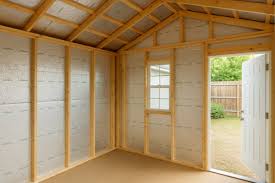
Beyond just comfort, there are structural and practical reasons to consider insulation.
Temperature Control and Comfort
The most obvious benefit is thermal regulation. Insulation acts as a barrier to heat flow. In summer, it prevents radiant heat from entering; in winter, it traps the warmth inside. This flattens the temperature curve, making the shed usable year-round rather than just in mild weather.
Battling Condensation
Effective metal shed insulation is the best defense against condensation. By creating a thermal break between the warm air inside and the cold steel sheet, you stop the condensation process before it starts. For anyone storing classic cars, electronics, or cardboard archives, this moisture protection is non-negotiable.
Noise Reduction
Steel sheds are notoriously loud. Heavy rain or hail on a tin roof can be deafening, making conversation or concentration impossible. Insulation dampens this impact noise significantly. Furthermore, if you are using power tools like grinders or saws, insulation helps keep the noise inside, keeping you in good standing with your neighbors.
Protection for Equipment
Temperature fluctuations cause expansion and contraction in materials, while moisture causes rust and mold. Insulation creates a stable environment that prolongs the life of whatever you store, from lawnmowers to sensitive camping gear.
When You Definitely Need Insulation
There are specific scenarios where skipping insulation will lead to regret.
The Home Office or Workshop
If you plan to spend more than an hour at a time in your shed, you need insulation. Whether you are welding, woodworking, or typing on a laptop, a stable temperature is essential for human safety and productivity.
Storing Sensitive Equipment
If you are building an insulated garage shed to house a vintage vehicle, electronics, or paper records, temperature spikes and moisture are your enemies. Insulation protects these high-value assets from environmental degradation.
Livestock or Feed Storage
For rural property owners, sheds often house animals or feed. Extreme heat can spoil feed rapidly and cause immense stress or even death to livestock. In these cases, insulation is an animal welfare requirement, not just a building preference.
When You Might Not Need It
Not every shed needs to be a climate-controlled haven.
Basic Garden Storage
If your shed is strictly for storing a wheelbarrow, plastic rakes, and sealed bags of potting mix, insulation is likely an unnecessary cost. These items are generally impervious to temperature changes.
Budget Limitations
If you are on a strict budget, you might opt to skip insulation initially. However, keep in mind that retrofitting insulation is often more difficult and expensive than installing it during the initial build.
Mild Climate Zones
In some very specific temperate zones where temperatures rarely drop below 10°C (50°F) or rise above 25°C (77°F), you might get away with simple ventilation rather than full insulation.
Types of Shed Insulation Available
Understanding your options helps you balance cost with performance.
Reflective Foil Insulation
This is the most common form of shed insulation Australia wide. It consists of a layer of foil laminated onto paper or plastic. It is excellent at reflecting radiant heat away from the roof. It is thin, easy to install during construction, and relatively affordable. It also acts as a vapor barrier against condensation.
Pros: Cheap, effective against radiant heat, great moisture barrier.
Cons: Minimal thermal resistance (R-value) against cold air.
Bulk Insulation (Glass or Rock Wool)
These are the “batts” you might see in a house ceiling. They work by trapping pockets of air to slow down heat transfer. This is ideal for regions with cold winters or for soundproofing workshops.
Pros: High R-value, excellent soundproofing.
Cons: Can be bulky, requires a cavity to sit in, loses effectiveness if it gets wet.
Sandwich Panels (Insulated Panels)
Modern construction increasingly favors insulated shed panels. These are structural panels consisting of an insulating foam core sandwiched between two metal sheets. They serve as the exterior wall, the insulation, and the interior wall all in one.
Pros: incredible thermal performance, fast installation, clean internal finish, airtight.
Cons: Higher initial material cost compared to single-skin steel.
Cost vs. Long-Term Value
When weighing the decision, you must look beyond the sticker price.
Initial Cost Comparison
Reflective foil is the cheapest option, adding a small percentage to your total build cost. Bulk insulation adds more due to the need for internal lining (like plywood or plasterboard) to hold it in place. Insulated panels have the highest upfront material cost but save on labor and framing time.
Energy Savings
If you plan to run an air conditioner or a heater in your shed, an uninsulated structure effectively throws money out the window. Insulation allows you to heat or cool the space efficiently, drastically lowering electricity bills over the lifespan of the structure.
Property Value Impact
A fully lined and insulated shed is often classified differently by real estate agents. It is seen as a “studio” or “flexible workspace,” which adds significantly more value to a property than a simple “storage shed.”
Final Verdict
If you are building a simple locker for garden tools, you can likely skip it. However, for the vast majority of Australian property owners, the answer is a resounding yes. The Australian climate is too harsh on both people and equipment to ignore thermal protection.
The benefits of condensation control alone make metal shed insulation a smart choice for asset protection. If you intend to work inside the shed, insulation transforms it from a metal box into a genuine extension of your living or working space.
Before you finalize your shed design, assess your local climate and be honest about how you will use the space. Investing in insulation now is far cheaper than fixing rust or retrofitting walls later.